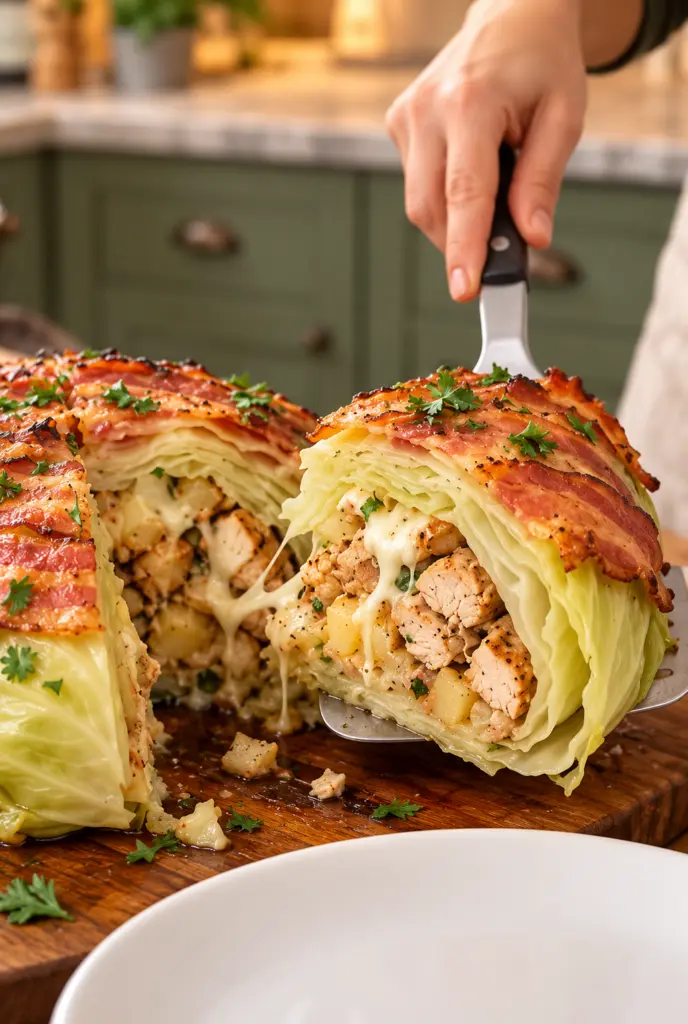
Bacon-Wrapped Stuffed Cabbage turns tender cabbage leaves into one generous, sliceable centerpiece filled with chicken, potatoes, and mozzarella. Overlapping bacon strips brown across the top, while garlic, paprika, and lemon give the filling a simple savory flavor.
A Cabbage Centerpiece for Sharing
This version is assembled like a savory dome rather than individual stuffed cabbage rolls. Softened leaves form the outside, and the filling holds recognizable pieces of chicken and potato with pockets of melted mozzarella. The bacon covers the crown and upper sides, adding a browned, savory finish.
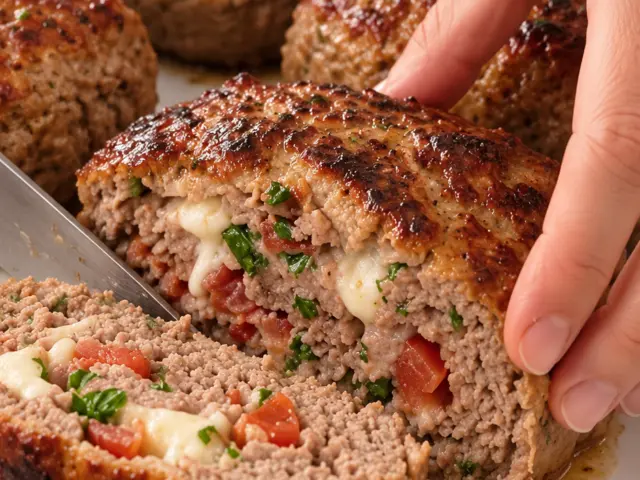
The supplied photo is the visual reference for the round shape, layered cut edge, and lifted wedge. The method below is developed from the listed ingredients; exact height, slice shape, and cheese stretch will vary with the cabbage, bowl, and ingredients.
Ingredients
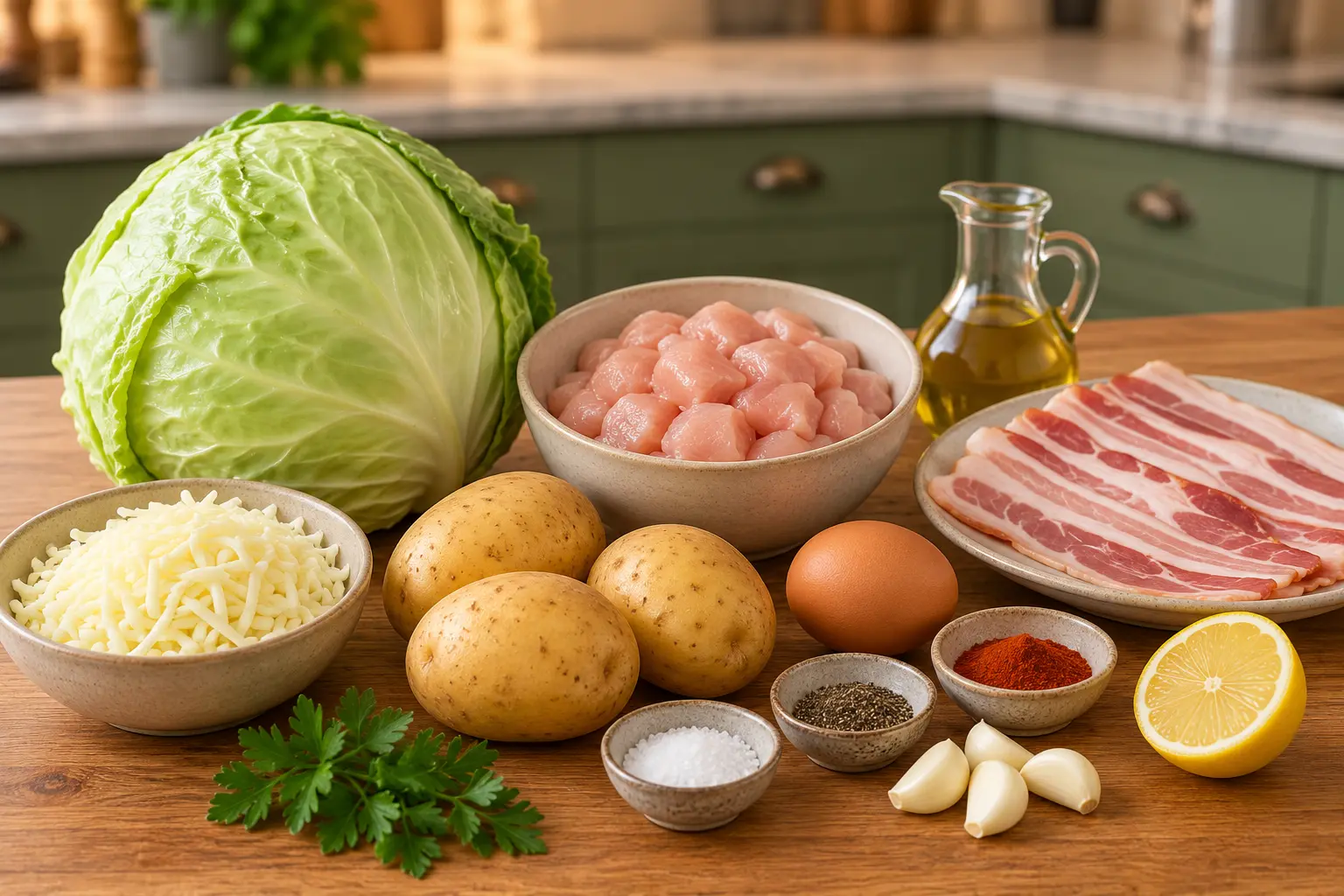
- 1 whole green cabbage
- 500 g chicken breast
- 150 g shredded mozzarella
- 2–3 medium potatoes
- 200 g bacon
- 1 large egg
- 3–4 cloves garlic
- Salt, to taste
- Black pepper, to taste
- 1 teaspoon paprika
- 2 tablespoons oil
- 1/2 lemon
- 2 tablespoons fresh parsley, optional
Dice the chicken breast, shred the mozzarella, mince the garlic, and chop the optional parsley. Juice the half lemon; the peel is not added. The 2–3 potatoes should give about 350–450 g after peeling. All of the potatoes go inside the filling.
How the Whole-Cabbage Shape Works
The whole head supplies broad outer leaves. After blanching, these are layered in a bowl to rebuild the shape around the filling. This lets you remove the tough core and control the leaf thickness instead of trying to roast a dense raw head until the center softens.
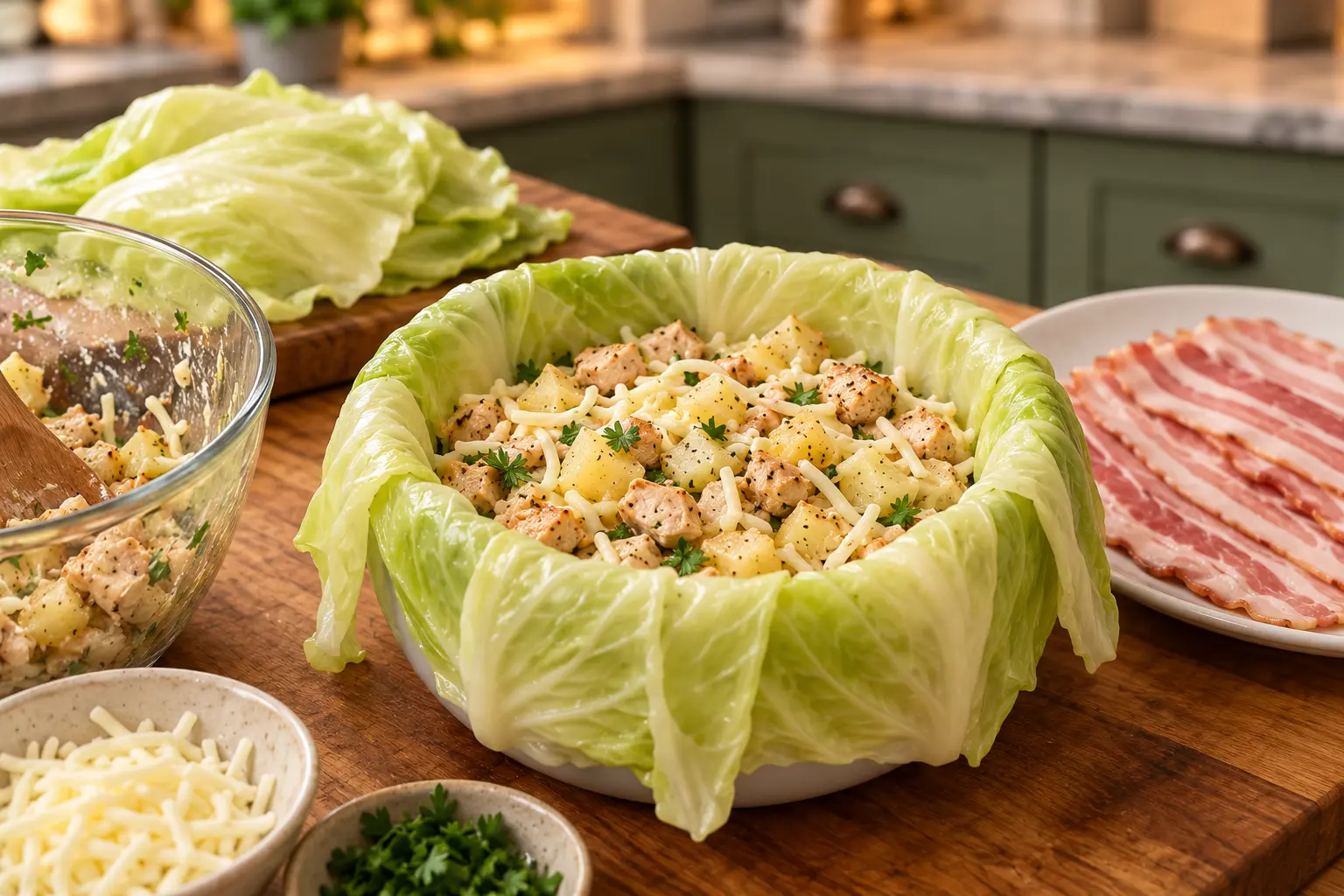
Use enough overlapping leaves to cover the filling securely, but save unused cabbage rather than creating an excessively thick shell. A few small tears can be patched with another leaf; place the most intact leaves against the bowl for a neater outside.
Equipment
- Large pot and tongs
- Saucepan
- Large skillet
- Sharp knife and cutting board
- Clean kitchen towels or paper towels
- Mixing bowl
- Round 7–8-inch shaping bowl, about 1.5–2 liters
- 9–10-inch round metal baking dish
- Aluminum foil
- Instant-read food thermometer
- Two broad spatulas
Instructions: Prepare the Cabbage and Filling
-
Prepare the cabbage leaves: Remove damaged outer leaves from the whole green cabbage and carefully cut out the hard core. Lower the head into a large pot of gently simmering water, allowing room so the pot does not overflow. After about 4–5 minutes, lift it onto a tray and use tongs to loosen the softened outer leaves. Repeat until you have about 12–14 broad intact leaves. Simmer the detached leaves another 3–5 minutes if needed, until tender and flexible but not falling apart. Reserve the unused inner cabbage for another meal.
-
Drain and trim: Let the leaves cool enough to handle, then pat them thoroughly dry. Shave the raised ribs flat without cutting through the leaves. Choose the largest, strongest leaves for the outside and smaller leaves for patching gaps. This recipe reshapes cooked leaves into one stuffed dome; it does not bake a raw, hollowed-out cabbage head.
-
Cook the potatoes: Peel the medium potatoes, aiming for about 350–450 g peeled potato, and cut into 1/2-inch (1 cm) cubes. Cover with water in a saucepan, bring to a simmer, and cook for about 8–12 minutes until fork-tender. Drain very well and let excess steam escape. Keep the cubes intact rather than mashing them.
-
Cook the chicken: Cut the chicken breast into small 1/2-inch (1 cm) dice. Heat 1 tablespoon of the oil in a large skillet over medium-high heat. Add the chicken, paprika, a little salt, and black pepper. Cook for about 6–8 minutes, turning the pieces, until the chicken reaches 165°F (74°C); time depends on size. Mince the garlic and stir it in for the last minute. Add the juice from the half lemon off the heat. Transfer to a bowl and let the chicken and potatoes cool for about 10–15 minutes until no longer steaming hot. Do not leave them out for an extended period.
-
Mix the filling: Taste the cooked chicken and potatoes and adjust salt and black pepper before adding the egg. Beat the egg, then gently mix it with the chicken, potatoes, and shredded mozzarella. If using fresh parsley, chop it and mix in 1 tablespoon, reserving the other tablespoon for serving. Do not taste the mixture after adding raw egg. Preheat the oven to 375°F (190°C).
Shape and Wrap the Cabbage
-
Shape the dome: Line a round bowl about 7–8 inches (18–20 cm) across, with roughly 1.5–2 liters capacity, with overlapping cabbage leaves. Create 2–3 overlapping layers around the base and sides, leaving broad edges hanging over the rim. Fill with the chicken-potato mixture, pressing gently to remove large gaps without packing it hard. Cover the filling with a leaf or two, then fold the overhanging leaves inward to seal the base. Use only as many leaves as needed; do not force the entire cabbage into the parcel.
-
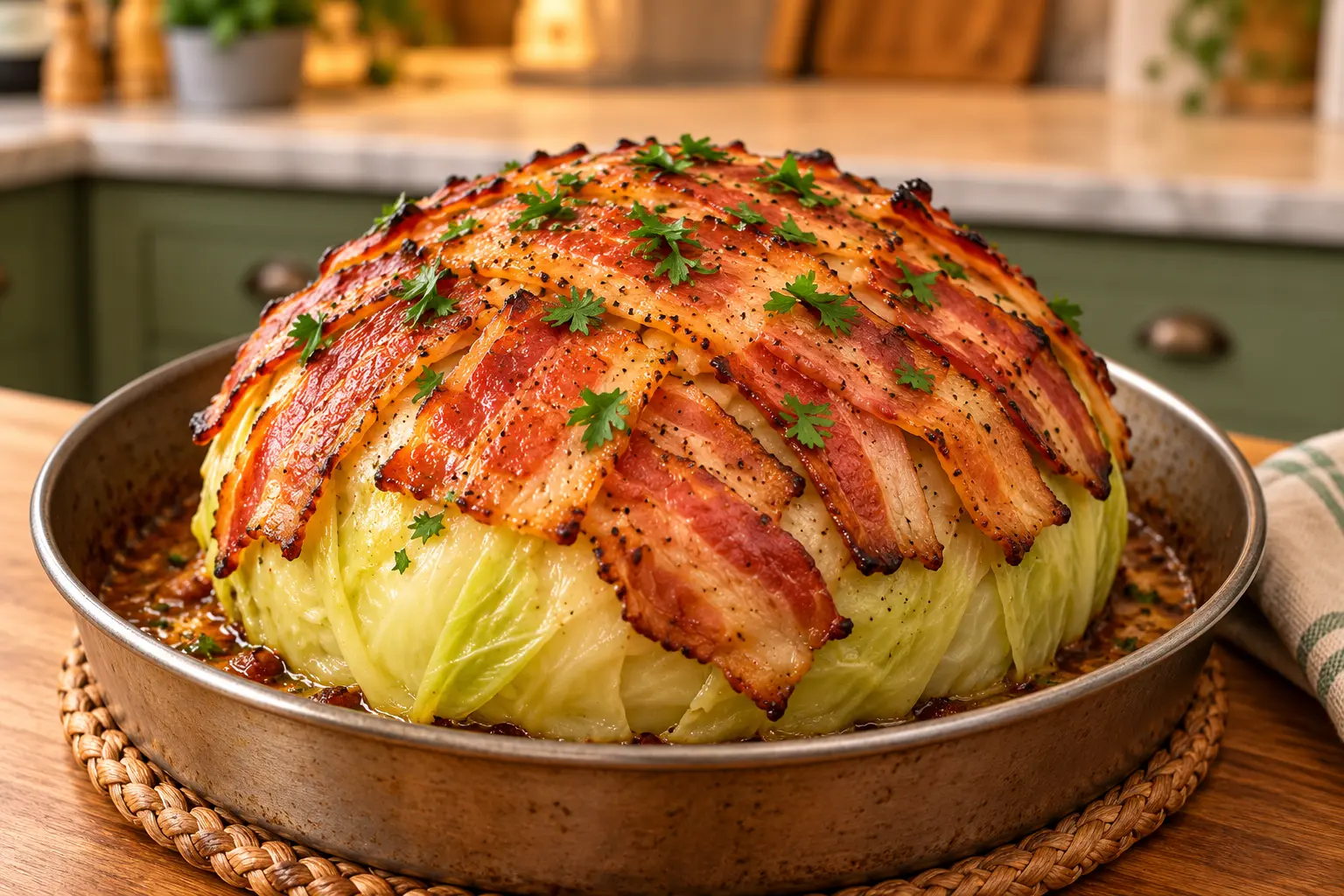
Turn out and wrap: Use the remaining 1 tablespoon oil to grease a snug 9–10-inch round metal baking dish. Hold the dish upside down over the bowl, grip both securely, and invert together. Lift away the shaping bowl, leaving the cabbage dome seam-side down in the dish. Drape the bacon in thin overlapping strips across the crown and upper sides, tucking ends under the lower edges where they reach. The 200 g bacon may not cover every lower leaf; avoid a thick multilayered bacon blanket.
The shaping bowl is only a mold and does not go into the oven. Once the parcel has been turned out, the folded seams sit underneath. Handle the inversion over a stable counter, holding the bowl and baking dish together firmly. If the parcel feels too fragile to move to a board later, serve it directly from the baking dish.
Bake and Rest
-
Bake: Cover the dish loosely with foil and bake at 375°F (190°C) for 40 minutes. Remove the foil and bake for another 30–45 minutes, or until the bacon is cooked and browned, the cabbage is tender, and the center of the filling reaches at least 165°F (74°C). Check with an instant-read thermometer in more than one central spot; browned bacon or melted cheese alone does not confirm doneness. If the top browns before the center is ready, re-cover loosely and continue baking. A larger or colder dome may take longer than 85 minutes total.
-
Rest and serve: Let the stuffed cabbage stand for 15 minutes. Transfer carefully to a board with two wide spatulas, or slice and serve directly from the baking dish. Cut into 6 wedges using a sharp knife, supporting each wedge with a broad spatula. Scatter with the reserved parsley if using. The filling will be soft and a few pieces may fall away; resting helps the slices hold together.
Check the Center, Not Only the Bacon
A dense cabbage parcel can brown outside before its middle is ready. Insert the thermometer into the center of the filling, avoiding the pan, and check a second central spot. The final target is at least 165°F (74°C). Keep baking under a loose foil cover if the bacon has enough color but the middle needs more time.
Some cooking liquid and rendered bacon fat in the dish are normal. Drying the leaves and draining the potatoes well keeps the filling from becoming unnecessarily wet. Do not use color alone to judge either the chicken during skillet cooking or the finished dome.
Helpful Tips
- Choose a cabbage with broad, undamaged outer leaves rather than a very tightly trimmed head.
- Blanch the leaves until tender and flexible, then remove surface water before layering.
- Shave the thick ribs down so the leaves lie flat without tearing.
- Cook both the chicken and potatoes before filling the dome; raw potato cubes may stay hard in the center.
- Let the cooked filling stop steaming before adding the egg so it does not scramble on contact.
- Use low-moisture shredded mozzarella rather than wet fresh mozzarella to limit excess liquid.
- Choose thin bacon strips. Thick-cut bacon can stay chewy where strips overlap.
- Keep the shaping bowl and baking dish close in size for support, and invert both together carefully.
- Use a thermometer in the middle, not just visual browning, to decide when the dish is ready.
- Rest before cutting and support each wedge with a wide spatula.
Simple Variations
- Omit the optional parsley for a simpler finish without changing the main filling.
- Use smoked paprika instead of regular paprika for a smokier flavor, keeping the same quantity.
- Choose 3 garlic cloves for a gentler flavor or 4 for a stronger garlic note.
- Keep the chicken, potato, egg, and cheese quantities unchanged for the first bake; the method depends on their combined filling volume.
Serving Ideas
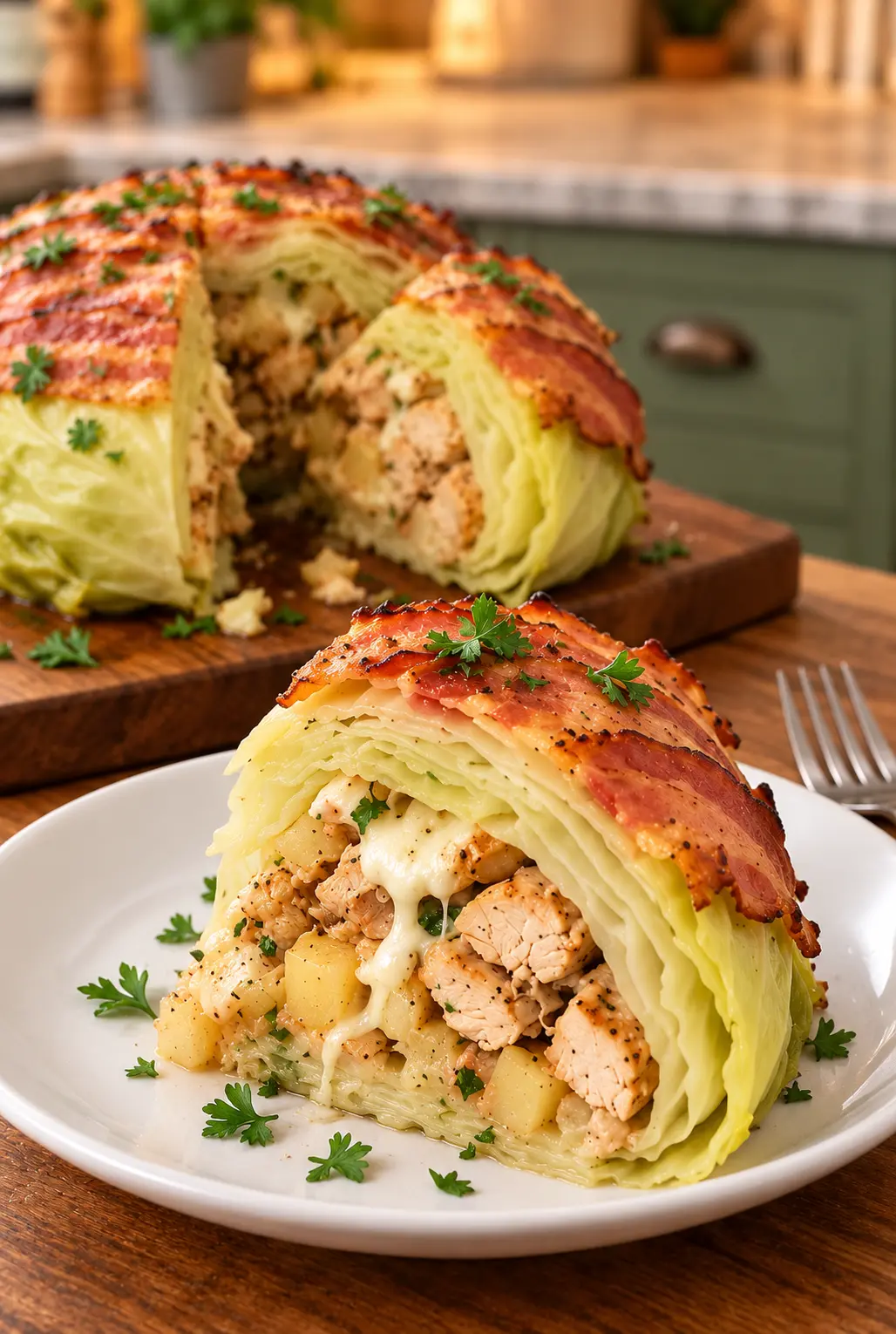
Cut the rested dome into about 6 wedges and use a broad spatula to lift each one onto a plate. Chicken, potatoes, cabbage, and cheese are already included, so a simple salad is an optional addition rather than a necessary part of the meal. Garnish with the reserved parsley, if using.
Timing and Yield
Makes 1 stuffed cabbage dome, about 6 servings. Allow roughly 45 minutes for preparation and assembly, about 30 minutes for blanching and precooking, 70–85 minutes in the oven, and a 15-minute rest. Some preparation can overlap with cooking. Plan around 3 hours overall, with extra time if the filling starts cold or the dome is larger.
Storage
Cut leftovers into portions and refrigerate in shallow covered containers within 2 hours, or within 1 hour if the room is hotter than 90°F (32°C). Keep the refrigerator at 40°F (4°C) or below and use within 3 days. Freeze cooled individual portions for up to 2 months for best quality. The cabbage will soften and the bacon will lose some crispness after storage.
Reheating
Thaw frozen portions in the refrigerator. Reheat wedges in a covered oven-safe dish at 350°F (175°C) for about 20–30 minutes, or until the center reaches 165°F (74°C). Uncover near the end to help the bacon dry slightly. Microwaving a covered portion also works, but the bacon will be softer; check the center and heat evenly.
Ingredient Notes
This recipe contains chicken, pork bacon, dairy, and egg. Bacon and cheese add salt, so season the filling lightly at first and taste the cooked ingredients before adding the raw egg. No exact nutrition estimate is provided.
FAQ
Is this made by hollowing out a raw cabbage?
No. This method blanches and separates the leaves, lines a bowl with them, adds the cooked filling, and reshapes everything into a cabbage-like dome. It produces the layered wedge presentation shown in the reference without leaving a hard inner cabbage core.
Do I use all of the cabbage?
You need enough broad leaves for overlapping layers and a closed base, usually about 12–14 depending on size. Save the inner cabbage and extra leaves for soup, slaw, or another meal.
Where do the potatoes go?
They are peeled, diced, cooked until tender, and mixed into the chicken filling. They are not raw potatoes underneath the cabbage or an additional side dish.
Why cook the chicken first?
Small cooked pieces are easier to season evenly, and this method avoids relying on the outside bacon color to judge raw chicken hidden inside a dense parcel. The assembled filling must still reach 165°F (74°C) because it contains egg and has been handled during assembly.
What does the egg do?
It helps bind the filling as it bakes. Add it only once the cooked ingredients are no longer steaming hot, and bake the finished dome thoroughly. It is not an egg wash for the bacon.
Will 200 g bacon cover the whole cabbage?
It depends on strip length and dome size. The intended finish covers the crown and upper sides, with some pale cabbage visible lower down. Thin strips and modest overlap give better coverage than thick stacked layers.
Why does my wedge fall apart?
Very wet leaves, an oversized dome, loosely tucked seams, or slicing too soon can make it fragile. Drain well, use a snug shaping bowl, rest for 15 minutes, and lift wedges from underneath. Some loose filling is normal.
Can I prepare it ahead?
You can refrigerate the fully cooked chicken, cooked potatoes, and blanched leaves separately for up to 1 day, then mix with the egg and cheese and assemble before baking. A cold filling needs extra baking time, so use the center temperature rather than a fixed timer.
Conclusion
Tender leaves, a fully cooked chicken-and-potato filling, and a snug round shape are the foundations of this Bacon-Wrapped Stuffed Cabbage. Bake until the center is hot and set, let it rest, and serve thick wedges with their golden bacon tops.
Print
Bacon-Wrapped Stuffed Cabbage
- Prep Time: 45 minutes
- Cook Time: 2 hours
- Total Time: 3 hours
- Yield: 6 servings (1 stuffed cabbage dome) 1x
- Category: Dinner
- Method: Baking
Description
A round cabbage-leaf dome filled with cooked diced chicken, tender potatoes, mozzarella, and an egg binder, topped with bacon and baked until hot throughout.
Ingredients
- 1 whole green cabbage
- 500 g chicken breast
- 150 g shredded mozzarella
- 2–3 medium potatoes
- 200 g bacon
- 1 large egg
- 3–4 cloves garlic
- Salt, to taste
- Black pepper, to taste
- 1 teaspoon paprika
- 2 tablespoons oil
- 1/2 lemon
- 2 tablespoons fresh parsley, optional
Instructions
Step 1 Prepare the cabbage leaves: Remove damaged outer leaves from the whole green cabbage and carefully cut out the hard core. Lower the head into a large pot of gently simmering water, allowing room so the pot does not overflow. After about 4–5 minutes, lift it onto a tray and use tongs to loosen the softened outer leaves. Repeat until you have about 12–14 broad intact leaves. Simmer the detached leaves another 3–5 minutes if needed, until tender and flexible but not falling apart. Reserve the unused inner cabbage for another meal.
Step 2 Drain and trim: Let the leaves cool enough to handle, then pat them thoroughly dry. Shave the raised ribs flat without cutting through the leaves. Choose the largest, strongest leaves for the outside and smaller leaves for patching gaps. This recipe reshapes cooked leaves into one stuffed dome; it does not bake a raw, hollowed-out cabbage head.
Step 3 Cook the potatoes: Peel the medium potatoes, aiming for about 350–450 g peeled potato, and cut into 1/2-inch (1 cm) cubes. Cover with water in a saucepan, bring to a simmer, and cook for about 8–12 minutes until fork-tender. Drain very well and let excess steam escape. Keep the cubes intact rather than mashing them.
Step 4 Cook the chicken: Cut the chicken breast into small 1/2-inch (1 cm) dice. Heat 1 tablespoon of the oil in a large skillet over medium-high heat. Add the chicken, paprika, a little salt, and black pepper. Cook for about 6–8 minutes, turning the pieces, until the chicken reaches 165°F (74°C); time depends on size. Mince the garlic and stir it in for the last minute. Add the juice from the half lemon off the heat. Transfer to a bowl and let the chicken and potatoes cool for about 10–15 minutes until no longer steaming hot. Do not leave them out for an extended period.
Step 5 Mix the filling: Taste the cooked chicken and potatoes and adjust salt and black pepper before adding the egg. Beat the egg, then gently mix it with the chicken, potatoes, and shredded mozzarella. If using fresh parsley, chop it and mix in 1 tablespoon, reserving the other tablespoon for serving. Do not taste the mixture after adding raw egg. Preheat the oven to 375°F (190°C).
Step 6 Shape the dome: Line a round bowl about 7–8 inches (18–20 cm) across, with roughly 1.5–2 liters capacity, with overlapping cabbage leaves. Create 2–3 overlapping layers around the base and sides, leaving broad edges hanging over the rim. Fill with the chicken-potato mixture, pressing gently to remove large gaps without packing it hard. Cover the filling with a leaf or two, then fold the overhanging leaves inward to seal the base. Use only as many leaves as needed; do not force the entire cabbage into the parcel.
Step 7 Turn out and wrap: Use the remaining 1 tablespoon oil to grease a snug 9–10-inch round metal baking dish. Hold the dish upside down over the bowl, grip both securely, and invert together. Lift away the shaping bowl, leaving the cabbage dome seam-side down in the dish. Drape the bacon in thin overlapping strips across the crown and upper sides, tucking ends under the lower edges where they reach. The 200 g bacon may not cover every lower leaf; avoid a thick multilayered bacon blanket.
Step 8 Bake: Cover the dish loosely with foil and bake at 375°F (190°C) for 40 minutes. Remove the foil and bake for another 30–45 minutes, or until the bacon is cooked and browned, the cabbage is tender, and the center of the filling reaches at least 165°F (74°C). Check with an instant-read thermometer in more than one central spot; browned bacon or melted cheese alone does not confirm doneness. If the top browns before the center is ready, re-cover loosely and continue baking. A larger or colder dome may take longer than 85 minutes total.
Step 9 Rest and serve: Let the stuffed cabbage stand for 15 minutes. Transfer carefully to a board with two wide spatulas, or slice and serve directly from the baking dish. Cut into 6 wedges using a sharp knife, supporting each wedge with a broad spatula. Scatter with the reserved parsley if using. The filling will be soft and a few pieces may fall away; resting helps the slices hold together.
Notes
Rebuild a dome with about 12–14 blanched cabbage leaves; reserve unused cabbage. Use 350–450 g peeled potatoes, cooked and diced inside the filling. Cook chicken fully before assembly, then bake the finished egg-containing filling to at least 165°F (74°C) in the center. Thin bacon covers the crown and upper sides; lower cabbage may remain visible. Oil is divided: 1 tablespoon for chicken and 1 for the baking dish. The 3-hour total includes the 15-minute rest and is approximate. Cut leftovers into portions and refrigerate in shallow covered containers within 2 hours, or within 1 hour if the room is hotter than 90°F (32°C). Keep the refrigerator at 40°F (4°C) or below and use within 3 days. Freeze cooled individual portions for up to 2 months for best quality. The cabbage will soften and the bacon will lose some crispness after storage.