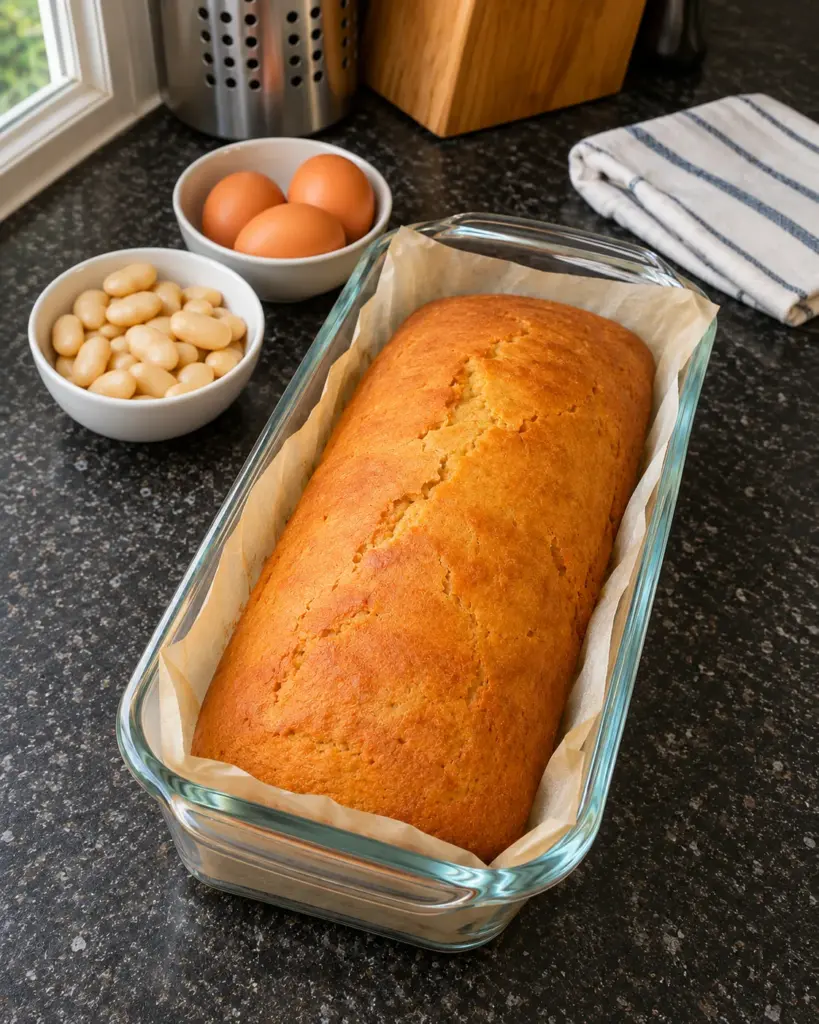
Flourless Butter Bean Egg Bread uses just three ingredients in its basic form: canned butter beans, eggs, and baking powder. The beans blend into a smooth batter, the eggs bind it, and baking powder helps it rise in the oven. The result is a soft, moist quick loaf that can be cooled, sliced, and toasted.
This version is different from butter bean bread made with flour. It has no wheat flour or yeast, so expect a tender, more compact crumb rather than the chew and height of a traditional sandwich loaf. Thoroughly draining the beans and baking the center all the way through are the keys to getting slices that hold together.
Why Make This Three-Ingredient Butter Bean Bread?
The short ingredient list makes it simple to try. Canned butter beans are mild in flavor and blend smoothly, while five eggs provide structure and protein. Baking powder gives the batter a lift without waiting for a yeast rise. There is no kneading or proofing, and a blender or food processor handles most of the mixing.
Serve slices toasted with a savory spread, use them as a base for breakfast, or add one of the optional seasonings for a different flavor. This is a practical recipe for anyone looking for a flourless quick bread, provided they enjoy the distinctive moist texture that bean-based baking brings.
Ingredients for Flourless Butter Bean Egg Bread
The Basic Three Ingredients
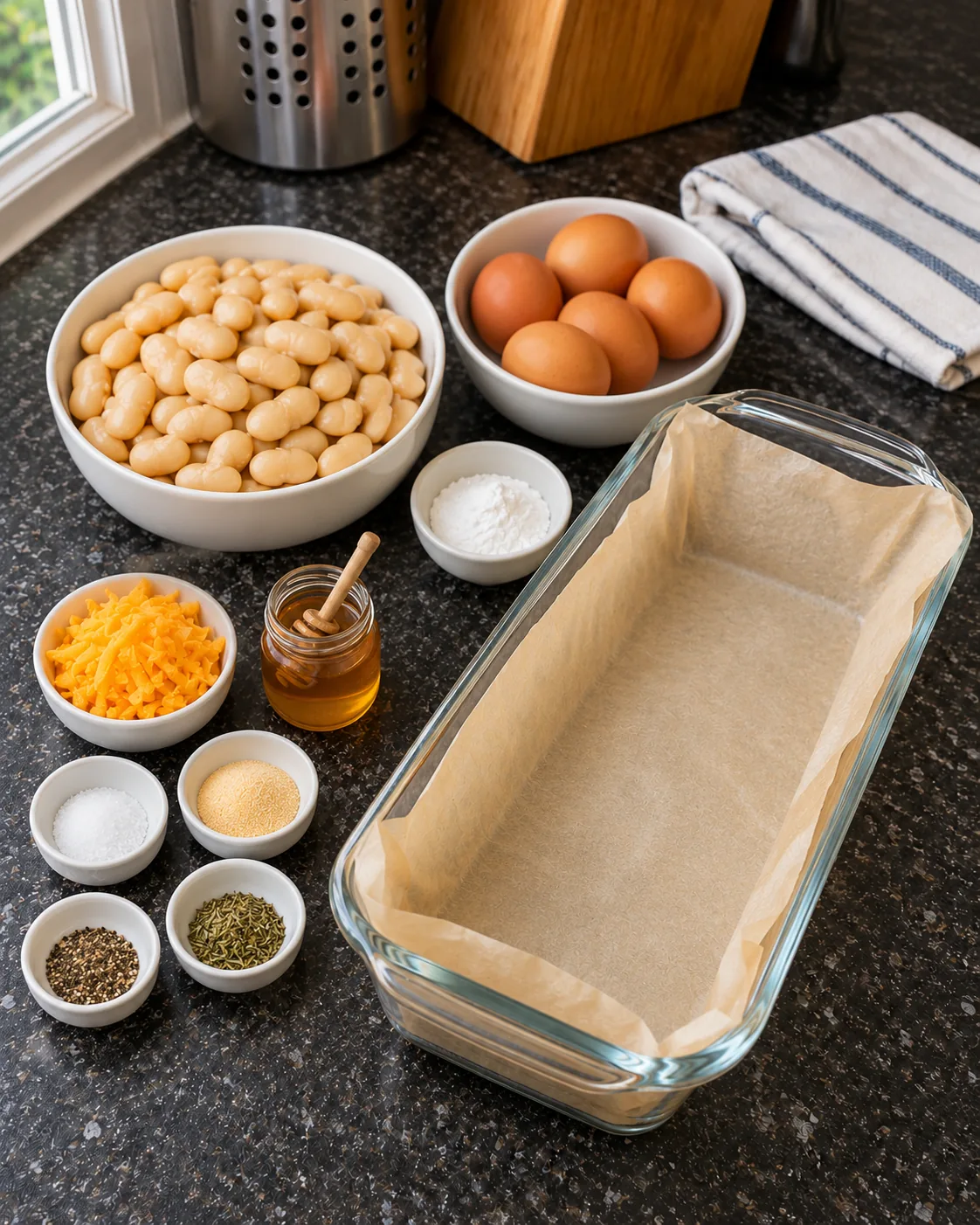
- 2 cans butter beans, 15 ounces each, thoroughly drained and rinsed—approximately 3 cups: Butter beans, also called large lima beans, form the body of the loaf. Drain them well and pat away surface moisture so the batter does not become watery.
- 5 large eggs: Eggs hold the bean purée together as it bakes. Use whole eggs and blend just until the batter is smooth and lightly aerated.
- 1 tablespoon baking powder: This is the only leavening in the base recipe. Make sure it is fresh for the best rise and add it just before the batter goes into the pan.
For the Pan
- Parchment paper: Line the loaf pan with a sling so the delicate bread can be lifted out after cooling. Parchment is a pan lining, not an edible fourth ingredient.
Optional Additions
The following additions are not part of the basic three-ingredient version. Choose a savory direction or a slightly sweeter one rather than adding everything at once.
- ½ teaspoon fine salt: Gives the mild beans more savory flavor.
- ½ teaspoon garlic powder: Good for savory toast or sandwiches.
- ¼ teaspoon cracked black pepper: Adds gentle warmth.
- 1 teaspoon dried herbs: Rosemary, thyme, or an Italian blend can perfume the loaf.
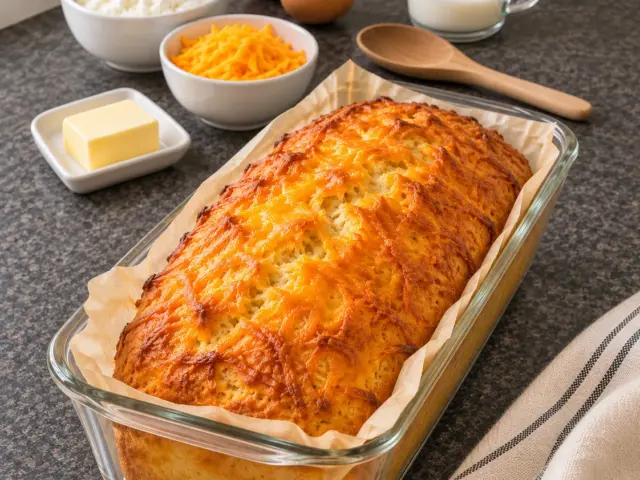
- ½ cup shredded cheddar: Fold into the batter at the end for a cheesy savory version. It increases richness and may slightly extend baking time.
- 1–2 tablespoons honey for a slightly sweeter loaf: Blend in with the eggs if choosing the sweet version. The loaf will still taste primarily of beans and eggs.
What Texture Should You Expect?
Because there is no flour, this bread will not behave exactly like a wheat loaf. It bakes into a moist, close crumb that firms as it cools. It can rise and split naturally on top, but the amount of lift depends on how dry the beans are, the freshness of the baking powder, your pan size, and how thoroughly the center bakes.
For neat slices, cool the loaf completely before cutting. A short chill after cooling can make it even easier to slice. Toasting brings out the edges and makes a slice sturdier for toppings. If you need a fluffy sandwich loaf, use a recipe with flour; this flourless version is its own style of quick bread.
Equipment and Pan Size
Use a blender or food processor, a spatula, and a parchment-lined loaf pan. An 8½ × 4½ inch pan produces a slightly taller loaf. A 9 × 5 inch pan like the one in the reference photo also works, but the loaf may be lower and can bake a little faster. A glass pan will brown differently from metal, so rely on the center of the loaf to judge doneness.
Leave parchment overhanging the long sides for easy lifting. Do not fill the pan right to the rim; the batter needs room to expand. If your pan is unusually small, set a little batter aside rather than risking overflow.
Instructions: How to Make Flourless Butter Bean Egg Bread
- Prepare the oven and pan. Preheat the oven to 350°F (175°C). Line an 8½ × 4½ inch or 9 × 5 inch loaf pan with parchment paper, leaving overhang on the long sides. Set the pan on a baking sheet if you want easier handling.
- Dry the beans. Drain and rinse 2 cans butter beans, 15 ounces each, giving approximately 3 cups. Leave them in a colander for several minutes, then pat them dry with a clean towel or paper towels. Excess water is one of the main causes of a wet center.
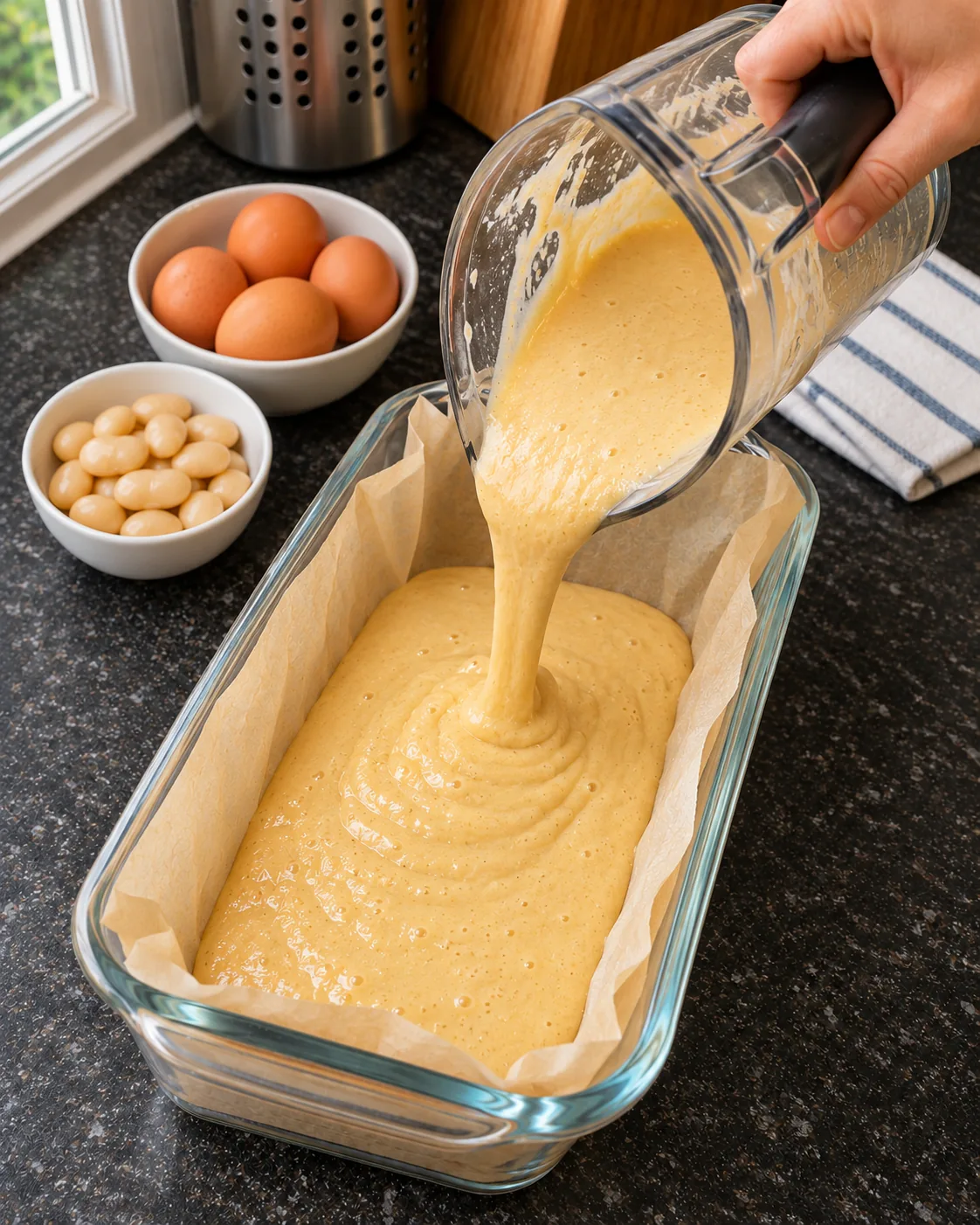
- Blend the base. Add the drained beans and 5 large eggs to a blender or food processor. Blend until completely smooth, stopping to scrape the sides. The batter should be thick but pourable, with no whole beans remaining. If using 1–2 tablespoons honey for a sweeter loaf, blend it in now.
- Add the leavening and optional savory flavors. Add 1 tablespoon baking powder and pulse only a few times to distribute it evenly. If using ½ teaspoon fine salt, ½ teaspoon garlic powder, ¼ teaspoon cracked black pepper, or 1 teaspoon dried herbs, pulse those in briefly as well. If using ½ cup shredded cheddar, fold it in by hand rather than blending it smooth.
- Fill the pan promptly. Pour the batter into the lined loaf pan, smooth the top lightly, and place it in the preheated oven without a long wait. Baking powder begins reacting once mixed with the wet ingredients.
- Bake until the center is set. Bake at 350°F (175°C) for about 55 to 65 minutes in the smaller pan; begin checking a wider 9 × 5 inch pan a little earlier. The top should be golden and feel set, a skewer inserted into the center should not carry wet batter, and an instant-read thermometer should read about 200–205°F (93–96°C). Tent loosely with foil if the top browns before the middle finishes.
- Cool completely. Let the loaf stand in its pan for 15 minutes. Lift it out by the parchment and transfer it to a rack. Cool for at least 1 hour before slicing; for the neatest slices, chill the fully cooled loaf for 30 minutes. Use a sharp serrated knife and cut gently.
How to Keep the Center from Turning Gummy
Drain thoroughly. Rinsing removes the canning liquid, but the beans still hold water on their surfaces. Let them sit in a colander and pat them dry before blending. Do not pour leftover liquid from the cans into the batter.
Blend completely smooth. Whole bean pieces can create uneven pockets. Scrape the blender jar and keep blending until the batter looks uniform. The smooth purée gives the eggs a better chance to bind the loaf evenly.
Use fresh baking powder. Expired baking powder may give little lift, which makes the loaf even denser. Measure a full tablespoon, level it, and mix it into the batter shortly before baking.
Check the middle, not just the crust. The top may turn golden while the center remains unset. Probe the thickest part with a skewer and, ideally, a thermometer. If the loaf is browning too fast, foil protects the top while the center finishes.
Allow a full cool-down. Bean-based quick breads continue setting as steam escapes. Cutting while hot compresses the tender crumb and can make it look underdone even when it has baked long enough.
Common Mistakes to Avoid
Expecting a wheat-bread crumb: Three ingredients without flour produce a different texture. This loaf is moist and compact, and it is at its best once cool and lightly toasted.
Leaving the beans wet: Extra liquid from the cans makes the batter thinner and can prolong baking. Drain, rinse, and pat dry before measuring and blending.
Adding baking powder too early: Blend the beans and eggs first, then pulse in the baking powder and bake soon afterward. Letting the mixed batter sit for a long time can reduce lift.
Overloading with additions: Cheese, honey, and herbs are optional and change the three-ingredient base. Too many moist or heavy additions can make the loaf harder to set. Start with one flavor direction and keep to the listed amounts.
Relying on a single bake time: Glass and metal pans behave differently, and pan size affects thickness. Check for a set center and use the 200–205°F temperature range as a guide.
Serving Ideas and Optional Flavor Versions
For a savory loaf, add salt, garlic powder, black pepper, and dried herbs. The finished bread can be toasted and topped with hummus, sliced tomato, or eggs. If adding cheddar, the loaf becomes richer and works nicely with soup. Keep the cheese optional so the basic version remains exactly three ingredients.
For a sweeter direction, blend in 1 to 2 tablespoons honey and skip the savory spices and cheddar. Toast a slice and serve with nut butter or fruit. The honey will not turn this into a sweet cake, but it gives the mild beans a gentler flavor.
Cut thick slices if the bread is fresh and thin slices after a short chill. A toaster or skillet gives the exterior extra structure. Handle hot slices carefully because the interior remains tender.
Storage, Freezing, and Reheating
Refrigerate: Once completely cool, wrap the loaf or keep slices in an airtight container in the refrigerator for up to 3 days. This moist egg-and-bean bread should not sit for days at room temperature.
Freeze: Separate cooled slices with parchment, wrap well, and freeze for up to 1 month. Thaw in the refrigerator or toast from frozen. Freezing the loaf in slices makes it easier to take out only what you need.
Reheat: Toast slices until warmed through and lightly crisp at the edges. You can also warm them in a dry skillet over moderate heat. Avoid microwaving for too long, which can make the texture rubbery.
FAQ: Flourless Butter Bean Egg Bread
Is the basic loaf really made with only three ingredients?
Yes. The edible ingredients in the base loaf are drained butter beans, five eggs, and baking powder. Parchment lines the pan. Salt, herbs, cheddar, honey, and other flavorings are optional and increase the ingredient count when used.
Does this loaf contain flour or yeast?
No. This recipe uses no flour or yeast. It is a quick bread that rises modestly from eggs and baking powder and bakes immediately after mixing.
Can I use canned butter beans?
Yes. The recipe is written for two 15-ounce cans. Drain and rinse them well; expect approximately 3 cups of beans after draining, depending on the brand.
Why did my loaf fall after baking?
A slight settling is normal for a flourless bean loaf. A dramatic collapse can happen if the center was underbaked, the batter sat too long after adding baking powder, or the beans carried too much water. Check the center before removing it from the oven.
Can I use a 9 × 5 inch pan?
Yes. The loaf will be somewhat lower than in an 8½ × 4½ inch pan and may finish earlier. Begin checking before the full 55 minutes and use the center’s texture and temperature to decide when it is done.
Is this the same as a regular sandwich loaf?
No. It is softer, moister, and more compact than flour-and-yeast sandwich bread. Cooling it fully and toasting slices make it easier to use for open-faced toppings.
Conclusion: A Simple Flourless Quick Loaf
Flourless Butter Bean Egg Bread is a useful way to turn beans, eggs, and baking powder into a sliceable quick loaf. Dry the beans, blend the batter smooth, bake the center thoroughly, and give it time to cool. Toast the slices for the best texture, then try one of the optional savory or lightly sweet additions on your next batch.
Print
Flourless Butter Bean Egg Bread (3 Ingredients)
- Prep Time: 15 minutes
- Cook Time: 65 minutes
- Total Time: About 2 hours 20 minutes, including cooling
- Yield: 10 slices 1x
- Category: Sourdough
- Method: Baking
Description
A simple flourless quick loaf made from drained butter beans, eggs, and baking powder, with optional savory or lightly sweet additions.
Ingredients
- 2 cans butter beans, 15 ounces each, thoroughly drained and rinsed, approximately 3 cups
- 5 large eggs
- 1 tablespoon baking powder
- ½ teaspoon fine salt, optional
- ½ teaspoon garlic powder, optional
- ¼ teaspoon cracked black pepper, optional
- 1 teaspoon dried herbs, optional
- ½ cup shredded cheddar, optional
- 1–2 tablespoons honey, optional for a slightly sweeter loaf
Instructions
Step 1 Preheat oven to 350°F (175°C). Line an 8½ × 4½ inch or 9 × 5 inch loaf pan with parchment paper, leaving an overhang for lifting.
Step 2 Drain and rinse 2 cans butter beans, 15 ounces each, approximately 3 cups. Leave in a colander for several minutes and pat dry to remove excess surface liquid.
Step 3 Blend the drained beans and 5 large eggs until completely smooth. If using 1–2 tablespoons honey for a slightly sweeter loaf, blend it in now.
Step 4 Add 1 tablespoon baking powder and pulse briefly to distribute. If using ½ teaspoon fine salt, ½ teaspoon garlic powder, ¼ teaspoon cracked black pepper, or 1 teaspoon dried herbs, pulse them in briefly. Fold in ½ cup shredded cheddar by hand if using.
Step 5 Pour batter promptly into the parchment-lined pan and smooth the top. Bake at 350°F (175°C) for about 55 to 65 minutes in the smaller pan, checking the wider pan earlier. The top should be golden, a center skewer should carry no wet batter, and the center should reach about 200–205°F (93–96°C). Tent with foil if browning too quickly.
Step 6 Rest in the pan 15 minutes, then lift out and cool on a rack for at least 1 hour before slicing. A 30-minute chill after cooling helps make the neatest slices. Serve toasted if desired.
Notes
Drain and dry the beans well to avoid a gummy center. Blend beans and eggs smooth, then add baking powder only just before baking. Expect a moist compact quick-bread crumb rather than a wheat-and-yeast loaf. Cool fully and toast slices for the best texture.