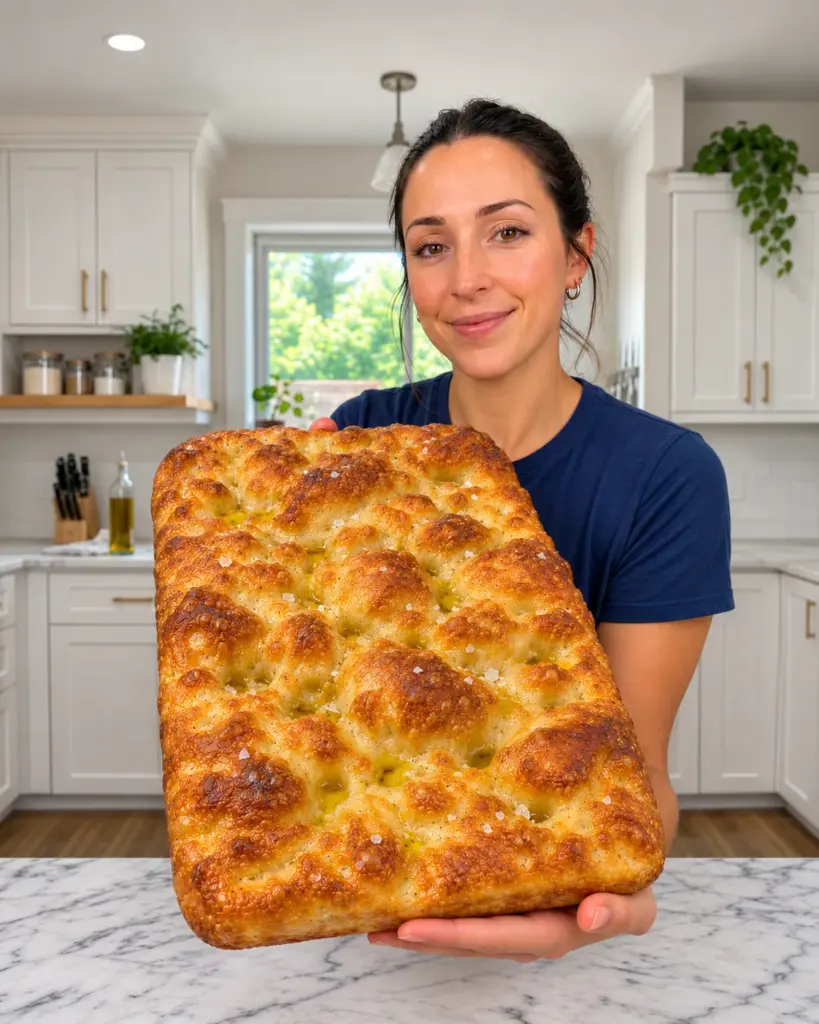
Easy Bakery-Style Bubble Focaccia Bread gets its personality from a moist dough, a generous coating of olive oil, and the big, irregular bubbles that puff and brown in a hot oven. The edges bake crisp, the interior stays soft, and each dimple catches a little oil and flaky sea salt. It looks dramatic on the table, yet the hands-on work is mostly stirring and a few gentle folds.
This recipe makes one generous 9 × 13 inch focaccia. Bread flour provides strength for the wet dough, while the long, airy rise builds the open texture. The basic version needs only flaky salt on top, like the golden loaf in the photo. Rosemary, Parmesan, cherry tomatoes, olives, and red pepper flakes are optional ways to change the flavor without changing the dough.
Why You’ll Love This Bubble Focaccia
The pan does much of the work. A layer of extra-virgin olive oil beneath the dough helps the bottom fry lightly as it bakes, giving the bread a flavorful crisp base. More oil on top helps the dimples deepen and makes the surface golden. The dough is intentionally sticky, so there is no need to knead it into a firm ball.
Bubble focaccia is also useful beyond a bread basket. Cut it into squares for soup, split larger pieces for sandwiches, or serve it alongside salad and pasta. Because it is baked as a large slab, you can cut small bites for a gathering or more substantial portions for a meal.
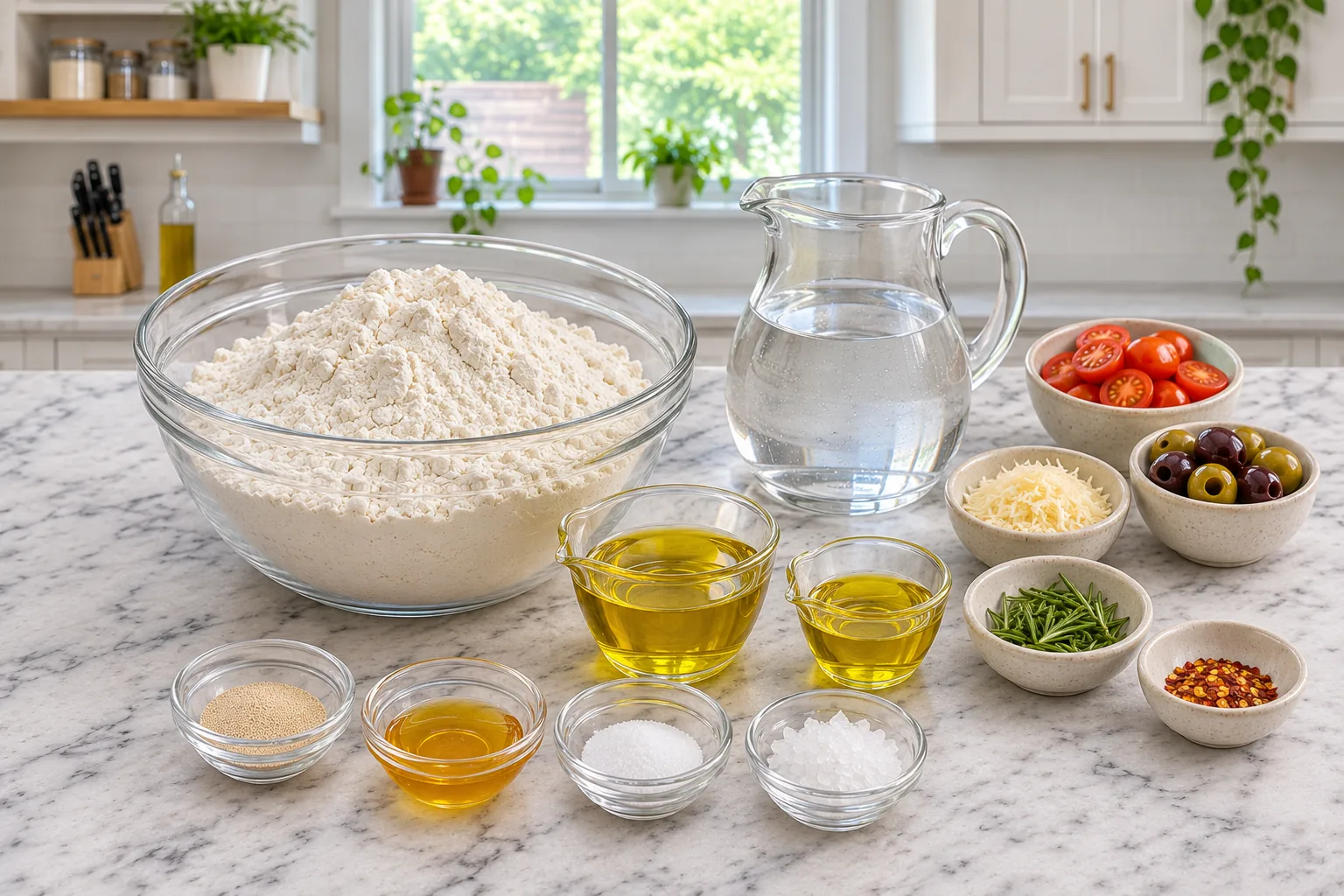
Ingredients for Easy Bakery-Style Bubble Focaccia Bread
For the Dough
- 4 cups bread flour, spooned and leveled: Bread flour has the strength to hold the dough’s generous amount of water and form bubbles. Spoon it into the cup and level it instead of packing it down.
- 1¾ cups lukewarm water, approximately 100–105°F (38–40°C): This gives the dough its loose, sticky feel and helps create an airy crumb. The water should be pleasantly warm, not hot.
- 2¼ teaspoons instant yeast: Instant yeast mixes directly into the flour and gives the dough a reliable rise.
- 1 tablespoon honey or granulated sugar: Either sweetener supports the yeast and helps the crust brown. Choose one, not both.
- 2 teaspoons fine sea salt: Seasons the dough itself. The flaky topping salt adds a different texture and should not replace this measured amount.
- 3 tablespoons extra-virgin olive oil: Mixed into the dough for flavor and tenderness.
For the Pan
- 3 tablespoons extra-virgin olive oil: Coat the bottom and sides of a 9 × 13 inch metal baking pan. The oil encourages a crisp underside and helps release the focaccia.
For the Topping
- 3 tablespoons extra-virgin olive oil, divided: Pour about 2 tablespoons over the dough before dimpling and brush or drizzle the last tablespoon over the hot bread after baking.
- ¾ teaspoon flaky sea salt: Scatter evenly over the dimpled dough for bursts of salty crunch.
Optional Additions
- 1 tablespoon fresh rosemary leaves: Add before baking for an aromatic, classic focaccia.
- ¼ cup grated Parmesan: Sprinkle over the bread for the last 8 to 10 minutes of baking so it colors without scorching.
- ½ teaspoon crushed red pepper flakes: Use lightly for a warm, spicy finish.
- ½ cup halved cherry tomatoes: Press cut side up into a few dimples, leaving plenty of dough exposed.
- ⅓ cup pitted olives: Scatter between dimples. Pat very wet olives dry first.
What Makes the Large Bubbles?
The combination of strong bread flour, plenty of water, gentle handling, and enough proofing time gives this focaccia its characteristic bubbles. A moist dough lets gas pockets expand. Short folds strengthen the dough without knocking all the air out. Once it is in the pan, letting it become visibly puffy before dimpling is the most important visual cue.
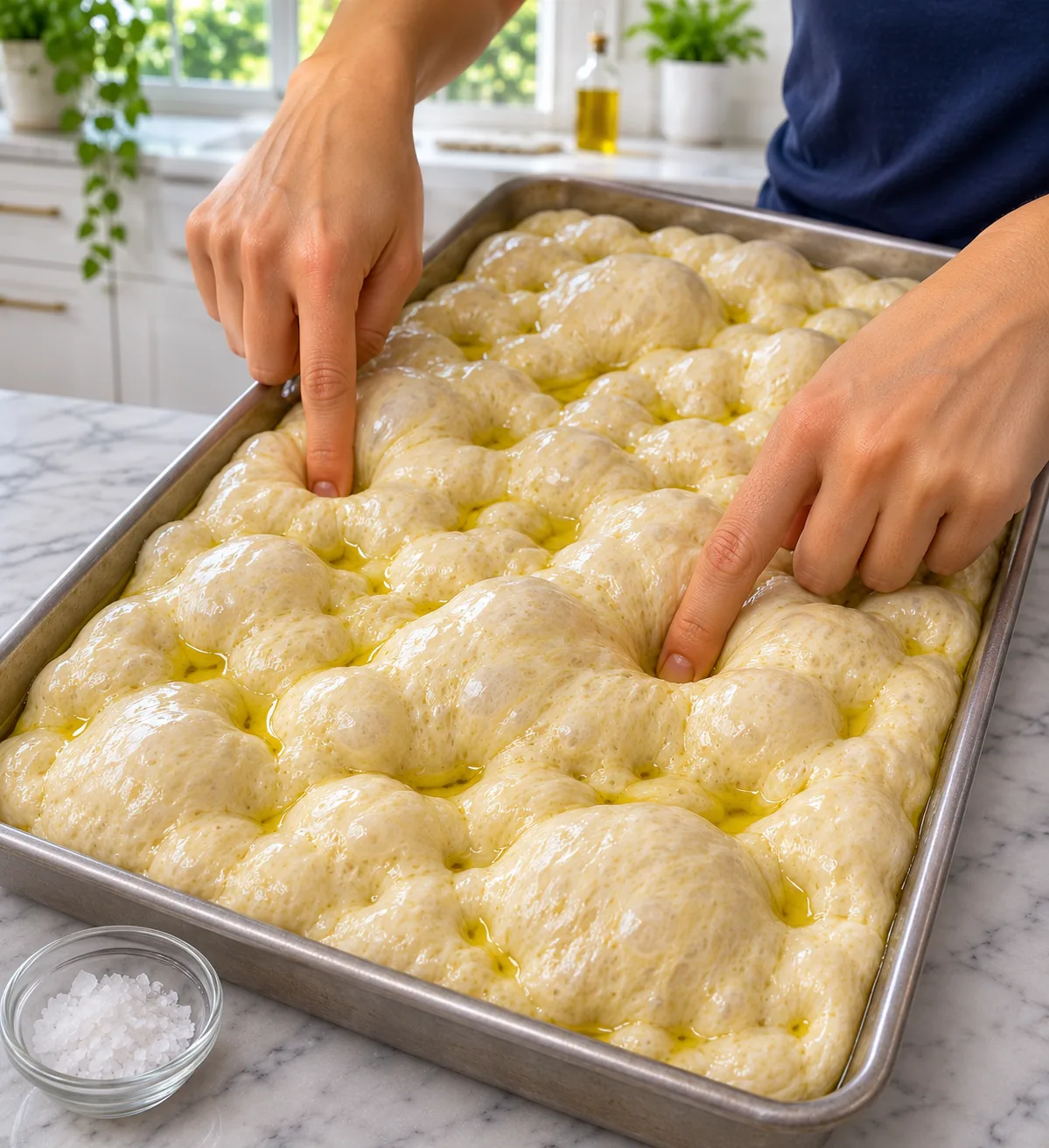
The final dimpling step is gentle but decisive: press your fingertips down through the dough until they nearly reach the pan, then lift them straight out. Do not mash the entire surface flat. Some pockets will stay large and dome upward in the oven, while the deep wells hold oil and salt.
Equipment and Pan Choice
Use a large mixing bowl, a spatula or sturdy spoon, and a 9 × 13 inch metal baking pan. A kitchen scale and instant-read thermometer are helpful but not essential. Metal pans usually give the crispest bottom. A glass dish can work, but it heats differently and may need a few more minutes; avoid sudden temperature changes with glass.
Measure all three portions of olive oil separately before you start: 3 tablespoons go into the dough, 3 tablespoons coat the pan, and 3 tablespoons are for topping. Keeping them separate prevents the dough from losing the oil needed to crisp its base.
Instructions: How to Make Bubble Focaccia Bread
- Mix the dough. In a large bowl, stir 4 cups bread flour, 2¼ teaspoons instant yeast, and 2 teaspoons fine sea salt together. Add 1¾ cups lukewarm water at approximately 100–105°F (38–40°C), 1 tablespoon honey or granulated sugar, and 3 tablespoons extra-virgin olive oil for the dough. Stir until no dry flour remains. The dough should be wet and sticky. Cover and rest for 20 minutes.
- Give it two gentle folds. With wet or lightly oiled fingers, lift one side of the dough and fold it toward the center. Turn the bowl and repeat on all four sides. Cover for 20 minutes, then repeat the four folds once more. Do not knead in extra flour.
- Let the dough rise. Cover and leave in a warm, draft-free place until expanded, bubbly, and roughly doubled, usually another 45 to 75 minutes after the folds. The exact time depends on room temperature, so use the dough’s appearance as your guide.
- Oil the pan and transfer. Pour 3 tablespoons extra-virgin olive oil for the pan into a 9 × 13 inch metal pan and spread it across the base and into the corners. Gently tip the risen dough into the pan. Turn it once to coat the underside with oil, then ease it toward the corners with oiled fingers. If it resists, rest 10 minutes and try again rather than forcing it flat.
- Proof in the pan. Cover loosely and let the dough rise about 45 to 60 minutes until it is visibly puffy with bubbles beneath the surface. During the last 20 minutes, preheat the oven to 425°F (220°C).
- Dimple and top. Drizzle about 2 tablespoons from the 3 tablespoons extra-virgin olive oil reserved for topping over the dough. Press oiled fingertips deeply and evenly into the surface, nearly to the pan, without collapsing every bubble. Sprinkle with ¾ teaspoon flaky sea salt. If using 1 tablespoon rosemary leaves, ½ teaspoon crushed red pepper flakes, ½ cup halved cherry tomatoes, or ⅓ cup pitted olives, add them now, keeping toppings fairly sparse so the bread can expand.
- Bake until deeply golden. Bake on the center rack at 425°F (220°C) for about 25 to 30 minutes. The focaccia should have crisp, browned high spots and a golden bottom. If using ¼ cup grated Parmesan, add it for only the last 8 to 10 minutes so it melts and browns gently.
- Finish and cool. Remove the pan from the oven and drizzle or brush the remaining 1 tablespoon topping olive oil over the hot bread. Rest for about 10 minutes, then lift or loosen the focaccia from the pan and place it on a rack. Cool another 10 minutes before cutting to keep the underside crisp.
Expert Tips for Big Bubbles and a Crisp Bottom
Keep the dough wet. It will cling to your fingers. Use water or olive oil on your hands instead of flour. Adding extra flour changes the hydration and can make the crumb tighter.
Do not rush the pan proof. The dough should look airy and tremble slightly when you shake the pan gently. If you dimple it before it has filled out, the bread may bake up short and tight.
Use enough pan oil. Three tablespoons may look generous, but that layer is part of the focaccia’s character. Spread it over the corners and sides, not just in a puddle in the middle.
Stretch in stages. Dough that springs back needs a short rest. Let it relax for 10 minutes and then coax it outward. Pulling hard can tear the gluten structure and press out bubbles.
Dimple just before baking. Oil the surface, press deeply, add salt and any toppings, then put the pan in the hot oven promptly. A long wait after dimpling can flatten the dough.
Move it to a rack. Leaving baked focaccia in an oily pan too long lets trapped steam soften the bottom. A brief rest makes it easier to remove, then a rack preserves the crisp texture.
Common Mistakes to Avoid
Using cool water and expecting a fast rise: Lukewarm water helps this same-day dough rise at a predictable pace. A cooler kitchen may simply need more time; do not turn the oven on low to proof the dough where it could overheat.
Pressing the dough flat repeatedly: The aim is to keep large pockets of gas. Fold the dough gently, ease it into the pan, and save the deep fingertip dimples for the final moment.
Overloading the top: Cherry tomatoes, olives, cheese, and herbs are delicious, but too many toppings weigh down the bubbles. Use the listed modest amounts, and spread them apart.
Taking the bread out too pale: Focaccia needs a confident golden-brown bake for a crisp bottom and flavorful blisters. Check the underside with a spatula if the top is done but you are unsure about the base.
Serving Ideas
Cut the warm focaccia into squares and serve with soup, pasta, a green salad, or a bowl of olive oil for dipping. For sandwiches, let it cool completely, cut into large rectangles, and split each piece horizontally. Its airy interior can hold roasted vegetables, cheese, or deli fillings without feeling heavy.
The basic salted version is versatile enough for many meals. Rosemary pairs well with roasted vegetables. Tomato and olive toppings make a more colorful appetizer. Parmesan adds savory depth, especially when sprinkled near the end of the bake.
Storage, Freezing, and Reheating
Store: Let the focaccia cool fully, then wrap it or keep it airtight at room temperature for up to 2 days. The crust is crispiest on the day it is baked.
Freeze: Cut into portions, wrap well, and freeze for up to 2 months. Separate layers with parchment so you can remove one portion at a time.
Reheat: Warm pieces in a 350°F (175°C) oven for about 8 to 10 minutes until heated through and the edges crisp again. Frozen pieces may need a few extra minutes. The microwave warms the crumb but softens the crust.
FAQ: Bakery-Style Bubble Focaccia
Why does my focaccia have small bubbles?
The dough may not have risen enough in the bowl or pan, or it may have been handled too firmly. Give it time to become visibly puffy, then dimple just before baking. Keeping the dough moist also helps the interior stay open.
Can I make the dough ahead?
Yes. After mixing and the folds, cover and refrigerate the dough overnight. Let it warm and become puffy before transferring it to the oiled pan. The exact timing varies with your refrigerator and room temperature.
Can I use all-purpose flour?
Bread flour gives the strongest structure for the large bubbles in this recipe. All-purpose flour can work, but the dough may be looser and the finished bread somewhat flatter. If substituting, handle it gently and watch the proof closely.
Do I need honey and sugar?
No. Use 1 tablespoon honey or 1 tablespoon granulated sugar. Either option supports browning and a balanced flavor.
Why is there so much olive oil?
The oil has three jobs: it flavors the dough, crisps the bottom against the pan, and gives the dimpled top its golden finish. Measure the dough, pan, and topping amounts separately.
Conclusion: Let the Dough Make the Bubbles
Easy Bakery-Style Bubble Focaccia Bread rewards a light touch. Mix the sticky dough, fold it gently, give it time to rise until airy, and bake it hot in a well-oiled pan. Finish with flaky salt and a little more olive oil, then cut into pieces while the edges are still crisp and the center is soft.
Print
Easy Bakery-Style Bubble Focaccia Bread
- Prep Time: 20 minutes
- Cook Time: 30 minutes
- Total Time: About 3 hours 15 minutes, including rising and cooling
- Yield: 12 pieces 1x
- Category: Sourdough
- Method: Baking
Description
One 9 × 13 inch pan of airy, bubbly focaccia with a deeply browned top, crisp olive-oil base, and flaky sea salt.
Ingredients
- 4 cups bread flour, spooned and leveled
- 1¾ cups lukewarm water, approximately 100–105°F (38–40°C)
- 2¼ teaspoons instant yeast
- 1 tablespoon honey or granulated sugar
- 2 teaspoons fine sea salt
- 3 tablespoons extra-virgin olive oil, for the dough
- 3 tablespoons extra-virgin olive oil, for the pan
- 3 tablespoons extra-virgin olive oil, divided, for the topping
- ¾ teaspoon flaky sea salt
- 1 tablespoon fresh rosemary leaves, optional
- ¼ cup grated Parmesan, optional
- ½ teaspoon crushed red pepper flakes, optional
- ½ cup halved cherry tomatoes, optional
- ⅓ cup pitted olives, optional
Instructions
Step 1 Stir together 4 cups bread flour, spooned and leveled, 2¼ teaspoons instant yeast, and 2 teaspoons fine sea salt. Add 1¾ cups lukewarm water, approximately 100–105°F (38–40°C), 1 tablespoon honey or granulated sugar, and 3 tablespoons extra-virgin olive oil for the dough. Mix until no dry flour remains; cover and rest 20 minutes.
Step 2 With wet or oiled fingers fold the dough from each of four sides toward the center. Cover and rest 20 minutes, then repeat one set of four folds. Cover and let rise until puffy and roughly doubled, about another 45 to 75 minutes.
Step 3 Coat a 9 × 13 inch metal baking pan with 3 tablespoons extra-virgin olive oil for the pan. Gently transfer dough into the pan and ease it toward the corners. If it resists, rest 10 minutes and continue. Cover and proof 45 to 60 minutes until visibly bubbly. Preheat oven to 425°F (220°C).
Step 4 Drizzle about 2 tablespoons of the 3 tablespoons extra-virgin olive oil, divided, for the topping over the dough. Press fingertips deeply into the puffy dough to make dimples. Scatter ¾ teaspoon flaky sea salt. If using 1 tablespoon fresh rosemary leaves, ½ teaspoon crushed red pepper flakes, ½ cup halved cherry tomatoes, or ⅓ cup pitted olives, add them sparingly now.
Step 5 Bake at 425°F (220°C) for 25 to 30 minutes until the top and bottom are deeply golden. If using ¼ cup grated Parmesan, sprinkle it over the focaccia for only the final 8 to 10 minutes of baking.
Step 6 Brush or drizzle the final 1 tablespoon topping extra-virgin olive oil over the hot bread. Rest in the pan for 10 minutes, transfer to a rack, and cool another 10 minutes before slicing.
Notes
Keep the dough moist and fold gently to preserve big bubbles. Let the dough become visibly puffy in the pan before dimpling. Spread all 3 tablespoons pan oil to the corners for a crisp underside. Add Parmesan only near the end so it does not scorch.